
ON-VEHICLE INSPECTION (Power steering) — Drive belts, fluid, leakage, hydraulic bleeding
ST-7prose procedureChecking and Adjusting Drive Belts
Refer to section MA for Drive Belt Inspection.
Checking Fluid Level
Check the level when the fluid is cold.
CAUTION
Do not overfill.
IMPORTANT
Recommended fluid is Automatic Transmission Fluid "DEXRON™ Type".
Checking Fluid Leakage
Check the lines for improper attachment and for leaks, cracks, damage, loose connections, chafing or deterioration.
Power-steering fluid-leakage check
- 1Run engine at idle speed or 1,000 rpm. Make sure temperature of fluid in oil tank rises to 60 to 80°C (140 to 176°F).
- 2Turn steering wheel right-to-left several times.
- 3Hold steering wheel at each "lock" position for five seconds and carefully check for fluid leakage.Do not hold the steering wheel in a locked position for more than 15 seconds.
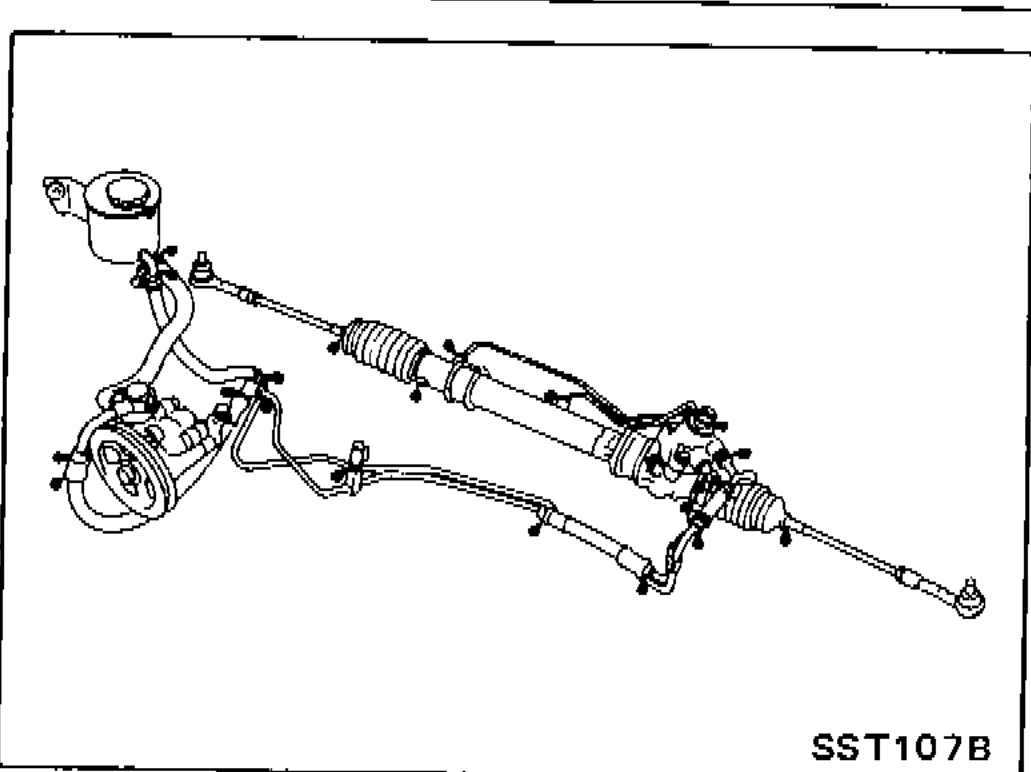 SST107B
 - 4If fluid leakage at connectors is noticed, loosen flare nut and then retighten.Do not overtighten connector as this can damage O-ring, washer and connector.
| Specification | Value |
|---|---|
| Fluid temperature for leak checkStep 1. | 60 to 80°C (140 to 176 °F) |
Fluid temperature for leak checkStep 1.
60 to 80°C (140 to 176 °F)
Bleeding Hydraulic System
Power-steering hydraulic bleeding
- 1Raise front end of vehicle until wheels clear ground.
- 2Add fluid into oil tank to specified level. Meanwhile, quickly turn steering wheel fully to right and left and lightly touch steering stoppers. Repeat steering wheel operation until fluid level no longer decreases.
- 3Start engine. Repeat step 2 above.
IMPORTANT
Incomplete air bleeding will cause the following to occur. When this happens, bleed air again.